Tag Archives: Review

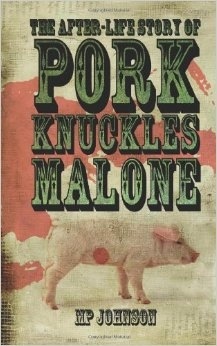
Review: The After-Life Story of Pork Knuckles Malone by MP Johnson (Bizzaro Pulp Press; 2013)

14 Dec

20141214-175801.jpg

I decided to read some of MP Johnson’s stuff because I’m working on a story to submit to his anthology about G.G. Allin. I read a hilarious flash fiction piece about maggot infested dolls in a Strangehouse Books Christmas anthology. I then wanted to read his newest book, Dungeons and Drag Queens, but it is not available digitally. I currently live and work in Bolivia where it is difficult to receive physical books. Then I discovered he’d written this other book called The After-Life Story of Pork Knuckles Malone.

This one pulls off a brilliant trick of rhetoric: its voice contains the cadences of a southern farmer accent coupled with pearls of farm-wisdom in a tone that borders on satirical but does not fully embrace its own irony.

Paper-mache-praying-mantis-mask-bedecked meat lovers abound. As do shacks haunted by pig spirits and baby arms where genitalia should be and filthy aunts and uncles in shock-rock punk bands.

House flies fall in love with Hitler as a boy remains love with his pet pig even after it is turned into cured ham. A Fight Club-like sequence follows as the novella’s ties to reality just gets looser and looser. A drag queen is introduced in a hitch-hiking experience gone wrong. A trippy sequence of interstellar space travel that becomes a weird amalgam of psychosis and blended genres (fantasy, science fiction and horror follows).

The novella ends with a bizarre concert scene that brought to mind the cult film Bad Boy Bubby–I’m not sure if MP Johnson has seen this film or if it was an intentional reference.

The book is a wacky and funny surreal adventure tale that will leave you chuckling and dumbfounded. Think of these scatterbrained notes and fractured summary as invitation for the psychedelic-horror inclined.

Check out MP Johnson’s blog and more info about his books here.

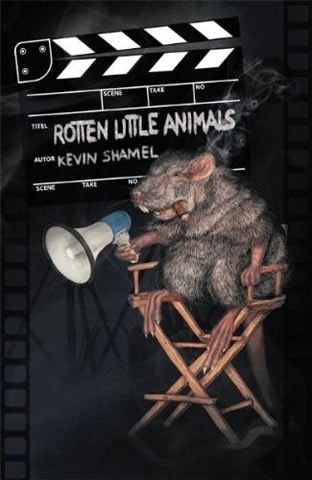
Review: Rotten Little Animals by Kevin Shamel (Eraserhead Press; 2009)

14 Dec

20141213-212955.jpg

Filthy animals directing films take a break to be rotten little voyeurs. You see: humans used to know animals could talk but they forgot.

What proceeds is a wildly unpredictable, crass, violent, and odd novella with plenty of action.

After the wicked carnage following the completion of a film about the kidnapping of a human boy, revenge is taken. From there, this gross but goofy gem of a novella hallucination gets wackier and wackier. The traumatized boy getting swallowed by a whale puppet is another highlight.

68, 412 ants talk in unison through a megaphone as a skunk sits in a director’s chair. Car chases through Yellowstone will have you on the edge of your seat until the novella’s shocking, yet surprisingly happy, climax.

Shamel writes in a clipped noir style yet his imagination is boundless. His plotting is daring and unexpected. He also has an original sense of humor. Bizzaro is a fun genre. Sometimes I struggle to identify what exactly unifies its authors in terms of approach, but this is one of the stronger examples I’ve encountered.

This will be a special treat for those who enjoyed the cult film Meet The Feebles, although that is not to say this is at all riding on its coattails. This is an entirely different beast altogether, full of more mind-bending ideas in a short psychedelic punch to consciousness than a poisonous mushroom.

Check out Rotten Little Animals at Eraserhead Press.

Review: The Farrowing by Jesse Wheeler (Strangehouse Books; 2014)

13 Dec

FARROWING-front-COVER

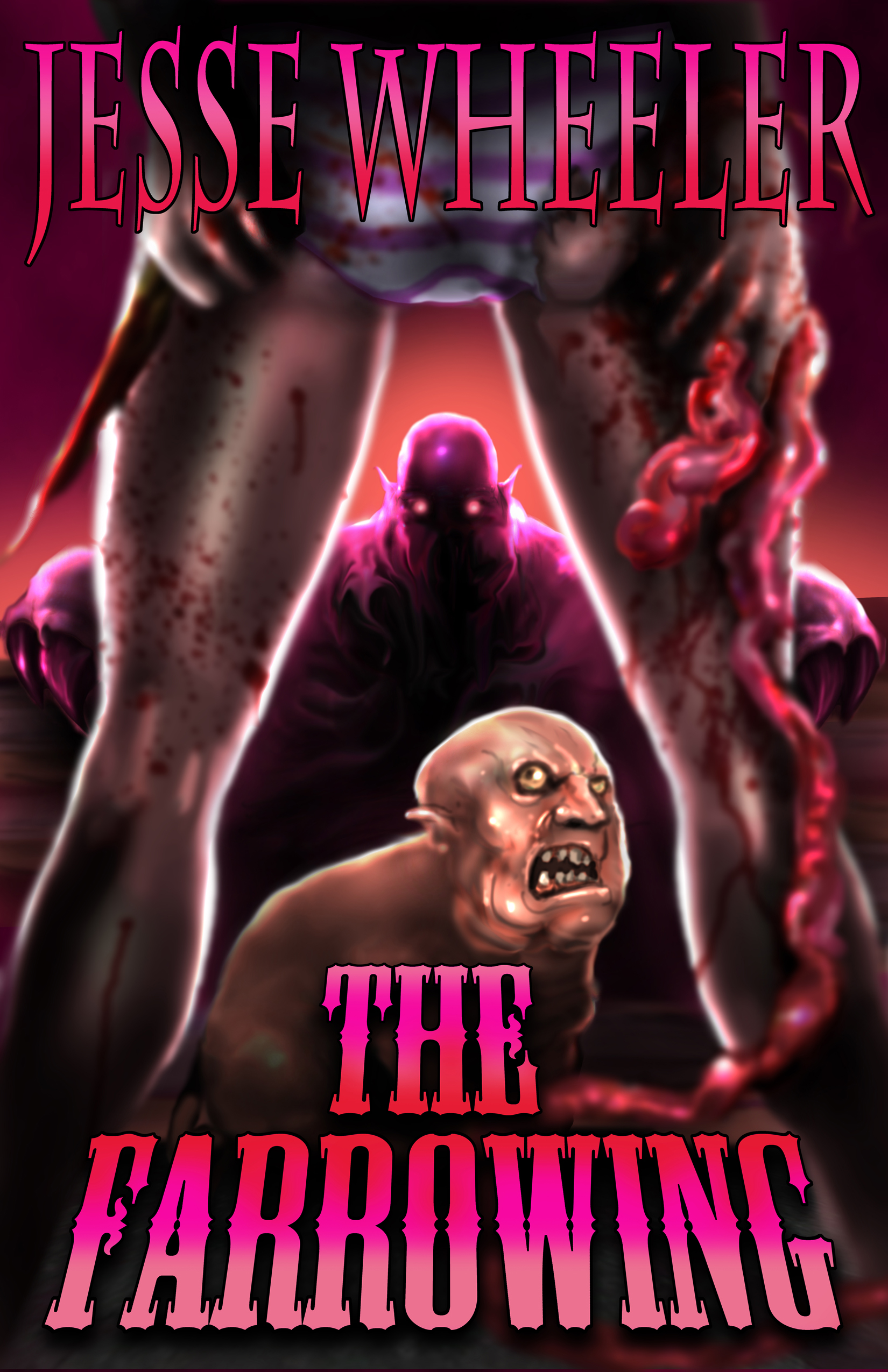
Mutant babies twisting in blue and purple veins somewhere in the dungeons below a good Christian family’s home. A pig with a human face trots into the master bathroom. Sublime toilet escapades abound in spades. Lost in underground tunnels. An obese man with pink velvet skin unleashes his floating tendrils, shining his sinister grin of demented ecstasy at his screaming prisoners drugged by the magical contents from the leather bag of a blue-skinned dwarf playing a flute.

These are just a few of the disturbing images from this depraved but imaginative book. Like in most 1980s body horror movies (Re-Animator, Society, From Beyond), the emphasis is more on spectacle, weird monsters, and a grotesque tableaux of mind-bending mutated set pieces rather than characters or palpable suspense. On second thought, the pages turned quickly on my screen during the escape scene in the middle of the book.

The image of the hideous “Pink Lou” was particularly imaginative, strange, and disturbing.

Some may find this book offensive or deranged, but Wheeler follows his imagination to the limit of bizarreness without censorship.

Check out The Farrowing at StrangeHouse Books

Review: The Least of My Scars by Stephen Graham Jones (Broken River Books; 2013)

12 Nov

scars-cover

Dreams of a glass-walled apartment beneath the city streets. The view? Darkness. Click the molars five times before answering the door, or you won’t deserve the gift the hallway has given.

Vegetable Ghost, Kid Hoodie, and Dashboard Mary may have arranged for the girl scout cookies to be left outside the apartment to which he’s been DIY-house arrested. Cellphones recording all the secret and polluted and artificial conversations to no one and nobody, the narrator’s two best friends. Evil often leaks from the past: picking at the least of his scars or being buckled in the backseat by his father all day. They monitor his perversions by how excited he gets from the images on his television in 15-minute increments.

Find goat hair to make devils and feathers for angels. Then swallow a marble to become blue cat-eye flame.

This odd novella takes place in an eerie void: unreliable narration, a web of anonymous apartments, and various characters who may or may not be figments of the narrator’s imagination. The style is clean, direct, and conversational, although there are many confounding and beautiful dark poetic nuggets sprinkled throughout. In one disturbing moment, our narrator sucks his cheeks in and chomps with all the force he can muster, at first disappointed he can’t taste blood gushing and then, when he succeeds, upset his teeth aren’t sticking from his face like toothpicks through a jack o’ lantern.

If you belong to Litreactor, there is an honest and deep article by Stephen Graham Jones called “Preparing for Company: Writing ‘The Least of My Scars'” about the dark but mind-expanding experience of writing this book. Apparently, he was struggling with a few different novels that didn’t quite come together when he began The Least of My Scars. This is a poignant and inspirational article for anyone who has tried to write novels over a sustained period. There is a sense of great elation and terrible defeat that comes with it. One hopes to be as dedicated as Stephen Graham Jones during the difficult periods.

I hope to read more of Stephen Graham Jones’ work, for his voice has definitely seared a new path of possibilities for what the novel can be.

check out The Least of My Scars here.

Review: The Imago Sequence by Laird Barron (Night Shade Books; 2009)

10 Nov

theimagosequence

“Old Virginia”

Toothless and horrible in a straightjacket. Turns your face cold blue as the white hairs flee the scalp. Riding the narrator into the woods to meet her mother. Annihilation. The doom of the world seen as invigorating by the demonic. Chained and left alone in an eerie cabin the woods. Tough guys. Canned laughter. Burning noir and war paperbacks to cinders of new language with the suspicious TALLHAT files.

“Shiva, Open Your Eye”

Unfortunate victims of blossoming. Poetry melting into confession stitched with delusions. Serial killer of essence of primordial evil distilled? Computers and religious texts clutched so firmly as if willed to turn to stone and connect to us. Mouth spitting crocodiles and devils: the sparks rippling through space and time, a cosmic hole for all sources and obliterations.

“Procession of the Black Sloth”

Alabaster blur of fish belly in the airplane bathroom’s black mirror. Belt buckle cameras, magpies fluttering past a poor man’s James Bond. Wigs smelling of cologne and cigarettes in the hall. Bags placed over heads and muddy face smudges left on the wall. A would-be swimmer accompanies a coven of witches. Tied up and screaming, they needed to get out of the tv and away from their long-necked children while climbing the mountain of mad knives.

“Bulldozer”

Mining towns where phalluses sculpted from human excrement lay on beds, deputies sleep off benders in jail cells, and certain death depends on the exchange rate. The hand of a severed arm clutches a locket under the bed. Some holes close while others open. Mycosis kills the trees as he opens portals, an evil magic sprung from disease. Animal skeletons hanging from the trees when you thought you heard a baby but it was just the wind. Leaf-eating parallax. Terrible flowers consume the essence.

“Proboscis”

Pretty girls at music festivals where kisses smear the flowers with the stars. Floating gray fur hands, coffee tasting of bleach. Predatory truck drivers don innocuous disguises. Awake with one light on in the bus, hiding from your abandoned child hovering in memory.

“Hallucigenia”

A half-dead horses violently thrashes against the seams of your life until a tall fellow emerges from the shadows with a conical hat. Screaming horses blotted by the clouds of pills and booze. Night sounds that may be hallucinations. Evil wizards in the alley outwit overseas real-estate tycoons/scumbags. Arm disappearing in a widening mouth, coughing up Demerol and 10 different kinds of booze. Blue label Stoli. Jacuzzis, the stars: post-coital. Head wounds refusing to heal where the horse head travels–yet the cries continue from her bedroom, although she is no longer there. Spaghetti for wigs as she crawls across the ceiling, porcelain face cracking. Wasp nest becoming the face of an old man on the barn ceiling. Beehive head, skinny arms…he slips through walls. Eel-ly old men drop sticky strands to reel you upwards.

“Parallax”

Scotch broom comes with the flowers to braid your bones in its hair for six years of an endless eternity. Hazy revenge. Getting off on a technicality in a first degree murder case. Or was she swallowed alive by a quantum boa constrictor? Photos in which she appeared as if in disguise were frequent, but she never stepped out of the newspapers or between the grains. Yet perhaps he–whose view is spider-eyed–cavorts with the disappearing too.

“The Royal Zoo is Closed”

Bloody thumbprint on the fridge spirals colossal shades of meaning and crippling possibilities. A disjointed but poetic journey follows with many brilliantly original turns of phrase.

“The Imago Sequence”

Photos could drive one mad, especially when separate from the exclusive triptych. He sees himself repeated, digs through the debris until the cockroaches scuttle over the sought face. A cool wind gathers about his heels(whiskey breath) and his brain gets altered both by interference and by the cold inner-workings of an inner bat machine that finally assembles its mechanical spells into something flight worthy as its leather wings start flapping and the night sucks its existence whole as if thirsty for a glimpse of trustworthy mechanical life.

Check out The Imago Sequence here.

“Mackintosh Willy” by Ramsey Campbell

30 Oct

20141029-211641.jpg

20141029-215319.jpg

Two coca cola caps stare out from within the darkness of “the shelter” where the graffiti grew gruesome after the alcoholic bum was found dead. It could’ve been a friend’s fault who later gets tugged along then below the shallow surface of mucky waters, his face transformed or smothered by a blurring bag or suffocating burlap. Girlfriends come and go but beside the carnival one always waits and watches, eyes glimmering unnaturally as if the outlines of glasses proved to be some alien’s or inhuman lifeform’s true sense of sight.

Check out “Mackintosh Willy” in Dark Companions.

“Be Light. Be Pure. Be Close to Heaven” by Sara Saab

30 Oct

20141029-204943.jpg

Tanta’s day for voluntary amputations will arrive by train. Her father has already sacrificed his eyes. Clean and sterilize all the precious body parts for the icebox. The eyes are jewels and so she touches them with the delicacy of feathers and egg-shell fingertips.

This story is told in a wonderful series of ice-prose sculpted fragments. You may feel disoriented by the eerie future world it inhabits or bewildered by the horrific sacrifices her weird/underground subset demands, but, in the windy end, the sheer ice crystal that blows through vacant limbs may just burn an icicle of ecstasy or a purple wand of pain.

Read the story in Black Static #42

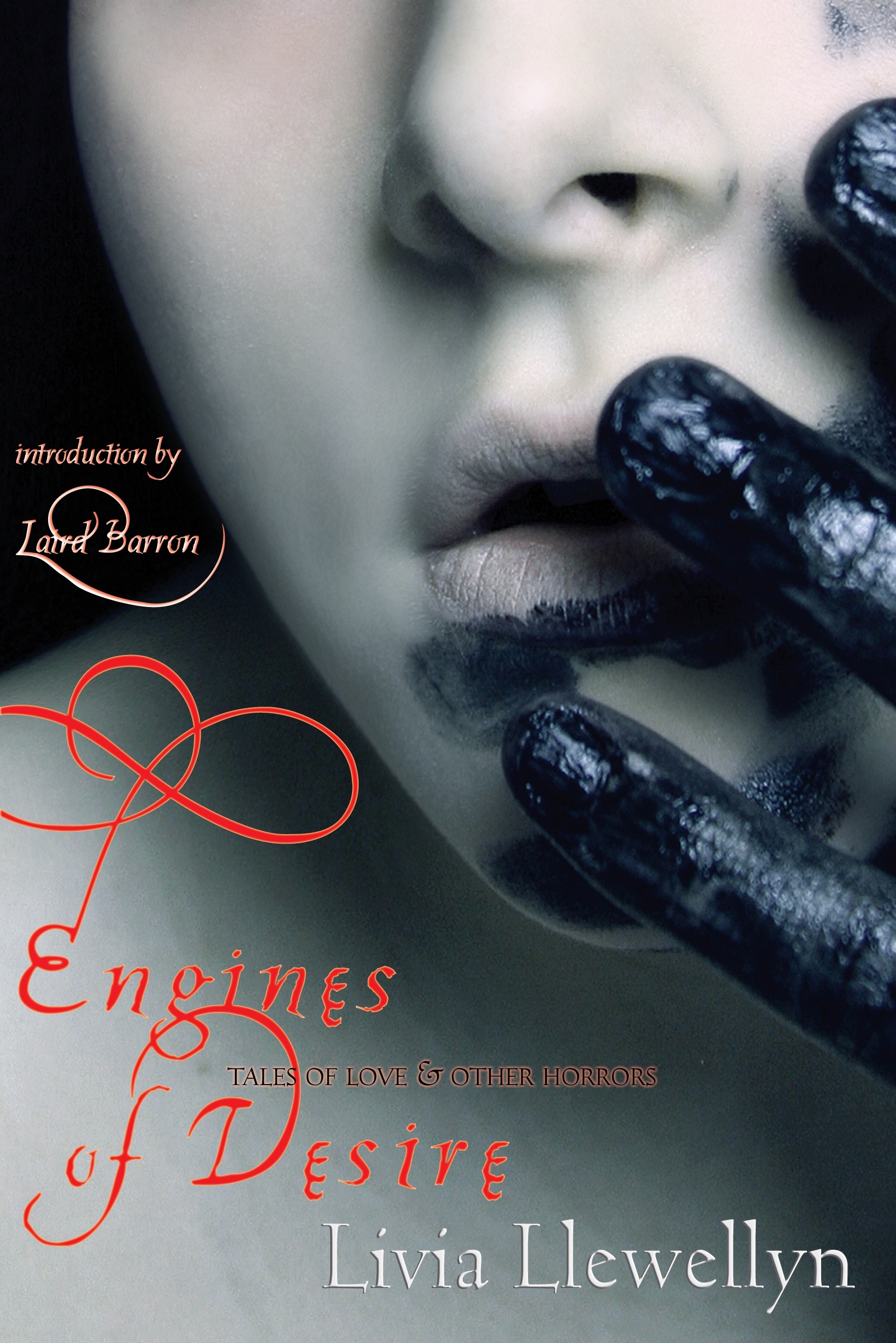
Review: Engines of Desire: Tales of Love and Other Horrors by Livia Llewellyn

27 Oct

20141027-175920.jpg

Livia Llewellyn, I think it’s time we put you under the phantasmic grille:

“Horses” is a post-apocalyptic hornet’s nest of a speculative fiction tale spun from a top flaming within a battle-weary heroine’s consciousness flayed from a damp life spent in a bunker rearing a child whom she does not love. Death howls for lullabies, Kingston thinks. The image of the pale rider in the photo is quite striking and mysterious–I do wish, however, that by the story’s end we could’ve found out in more detail exactly what changed while Kingston hid underground, yet maybe the ironic point was that nothing changed.

“At The Edge of Ellensburg”

Distant guitar chords strumming and crackling in a sultry backseat, summer’s fangs ripe with blood. This is one of the most disturbing stories I have ever read. One often doubts the sanity of the narrator and the raw eroticism has a chilling effect. Livia Llewellyn takes you deep into a dark and twisted psyche in this one, reluctant to raise the reader’s head for a gasp of air. This is a story I will not soon forget.

“The Teslated Salishan Evergreen”

Girls are ghosts in trees, fighting upstream through currents of electricity to be worshiped like living gravestones.

“Engines of Desire”

Engines sound, then take your hand to lead you to the furnace of the past where a sister goes missing and a girl from the cul-de-sac sneaks you into a haunted house where a furnace consumes souls and cajoles desires to a fever pitch. Girls are warm summer cream getting skimmed away (p. 41%) as the generations sink and tumble and other girls get swept away with the ashes to the engine forests as they teach french kissing after the lesson has already been firmly learned.

“Jetsam”

As the narrator sells some of her old books in this tale, a piece of paper is discovered by the bookseller. It is written in her handwriting yet she does not recall writing it. What follows is a series of eerie scenes depicting the dissolution of her former life and publishing job, the note (and a random/befuddled/questioning boy) offering clues toward a reconstruction of what happened…which is vague, though I often found myself hearing symbolic but mysterious echoes to 9/11, although it is never directly referenced. Livia Llewellyn evinces an array of quite different styles in each piece so far–sometimes to the point where I ask myself: is this the same writer?

“The Four Hundred Thousand”

Wombs and eggs to house the dog-faced soldiers. This post-apocalyptic tale one was more humorous than “Horses,” yet themes of abandonment and betrayal recur–although not with the unforgettable horror/resonance of “At The Edge of Ellensburg.”

“Brimstone Orange”

The creature that emerges from the fruit trees never goes inside the forbidden rooms either, but maybe another seance with the local girls could call them both back out of the woodwork…or at least retract the rotting fruit from the fat flies’ stomachs.

“Bring Your Daughters To Work”

The factory is a beautiful ocean. An entire family depends on the success of a daughter (a theme we also encountered in “The Four Hundred Thousand”). Gothic sea fantastic imagery grips this dark, inside-out The Little Mermaid-esque tale like a formal choker around a throat.

“Omphalos”

A dangerous god weaves through the forest to save the queen daughter in the backseat of a car on a family vacation as she plays lower lip-biting games beneath the living map. Clinging to a black void when father stands outside the room at night. Different maps for each member of this warped family, allowing universes to open yet further scramble preceding puzzles. The sky cracks into spirals as the map bulges and impregnates. No wolves should ever lick snow this cold, unless they wish for every last taste-bud to freezer rash.

“Her Deepness”

Perfect cursive on every gravestone by the canary. Seeing mines and holes in reality long after the search for coal extinguished. Decaying bodies melt when pushed back into the land that bore them. Trains shift into aquariums bearing mutant prisoners. Wormskill. Respirators preventing conversations with gods. Angry fertility stones becoming immortal. Plunging into anthracite voids, spreading black wings beyond the colors in oil and puma leather.

‘Twas a jolly ride on my reindeer skeleton sleigh through these cursed pages of one LL.

Check out Engines of Desire: Tales of Love and Other Horrors here

Review: The Light Is The Darkness by Laird Barron (Arcane Wisdom; 2012)

22 Oct

20141022-093132.jpg

Hurling middle-aged weaponry to shatter bamboo. A lost sister, preparing for the search.

Deja vu in the backseat of the parents’ car with a hallucinated old man in a space suit claiming that “time is a ring.” Eating people in occult rituals. Chainsmoking in front of a sink towering with dirty dishes and broken wine glasses: images of Imogene. Faded postcards. Dialogue from hardened, cold-war dime novels. Tough guy brief. Tears that always dry to fast… ever to see.

There is a manly lushness to Barron’s writing that sometimes reminded me Robert E. Howard’s Conan tales (the boar feast in this book comes to mind).

Vicious, testicle-grabbing Finn gladiators throwing local toughs through windows.

Ghostly figures in the backgrounds of photos. Messages from unseen forces needing to be unscrambled. Surreal images (like red infants, squealing hogs, and crocodiles spinning underwater while chewing deer) as Conrad(a gladiator) gets beaten by the aforementioned, testicle-grabbing Finn.

Men with antlers staring out of glossy photos found in a crawlspace.

Phantasmal woman shapes hover above a bed after the trigger word is uttered and all the meaning in the world begins to truncate and collapse.

Sundews crying and cloying for nourishment in a hive-like apartment as the room wobbles and shrinks. Fiendish cults. Rumors that split apart and burn clandestine images, drowning the surface while marbling the emulsion.

Car-door chewers, gun-shot wound absorbers. This novel has some horror and some post-apocalyptic sci. fi elements as well. DNA mutation/optimization?

Inhuman faces hidden at the dark epicenter’s vanishing point beneath the cowls. Battling brutes with ghoulish superpowers in a dank and abandoned family home.

Barron is a strange and original writer indeed. At times I found myself wondering to what sort of genre this book should belong. Sci. fi? Horror? It became increasingly unclear and ceased to matter. Barron has an obvious love for the pulps but is a far more accomplished, Cormac McCarthian wordsmith than most other horror writers.

I haven’t read Barron’ short story collections (though I hope to do so soon), but I would place him in the ranks of writers like that to genre-bend pulpy tropes into unique/original fiction like Neil Gaiman, Clive Barker, China Mieville, David Mitchell, and Haruki Murakami.

Devilish hallucinations (or visitations) for our genetically mutated superhero Conrad by his immortal (or dead) bat-like sister’s beyond-the-grave or beyond-human-shape form.

The title takes on a definite irony by the novel’s end. Barron’s style is quite unique, conjuring superhero comics with gothic and surreal painterly effects. I look forward to reading his short story collection trilogy.

Check out The Light Is The Darkness here.

Review: Unseaming by Mike Allen (Antimatter Press; 2014)

20 Oct

unseaming_mockup

“The Button Bin” is a disorienting and brilliant piece of disturbing horror fiction. Its fragmented, intuitive structure bends reality on a number of levels: a traumatic sexual experience between half-siblings, drug addiction, and an odd supernatural entity that controls people by warping them into beings immersed in a chest of semi-living buttons. The use of second person makes you complicit in the shifting seas of alternate realities this masterful and terrifying tale inhabits.

“The Blessed Days” are those on which we awake still entwined in passion, a blood not mine own risen to the surface of the skin. There were strange medusas of veins and flesh growing out of bathtubs, but then we knew the blessing was merely a trance one’s blood shawl could jump and shy away from, forever withholding a kingdom of nails.

In “Humpty” we encounter a terrifying, Chucky-like stuffed toy version of the cherished figure from the nursery rhyme; however, this is an evil doll who can also take our narrator into a variety of alternate dimensions, all with macabre consequences having already occurred…but not necessarily irrevocably. A creepy and original tale–my second fave. after the (probably) unsurpassable “The Button Bin.”

“Her Acres of Pastoral Playground” takes place on a farm where beauty marks morph into nefarious spider-like appendages. An odd, crop circle-like spot in the field proves to be an ominous deflection but also a sort of mysterious portal as this cosmic horror tale pulls together dispersed fluids and body substances of our narrator’s loved ones to suggest a scientific/body horror approximation of a religious experience.

“An Invitation Via Email” is incredibly funny in its casual, cavalier approach to extreme occult and Satanic sacrificial ritual. One might also note how coyly Allen cc.’s one of the emails to ligotti@morbid.net since his work is heavily indebted both to Ligotti that Lovecraft in equal measures.

“The Hiker’s Tale” is another fractured, intuitive horror tale featuring deep-in-the-woods, ghostly mysteries and echoes of Hansel and Gretel. I had the same feeling at the end of this tale as some of the others: a few disparate narrative threads (some in other time periods, dimensions, or consciousnesses) weave together by the story’s end to form a disorienting, confounding, yet entrancing mosaic.

“The Music of Bremen Farm” ends with a spectacularly phantasmagoric and hallucinatory scene that is funny and nightmare-inducing, like many masterful scenes in horror (Sam Raimi’s horror films and An American Werewolf in London come to mind). The image of the smiling donkey chomping into a police officer’s hand is not one I’ll soon forget.

“The Lead Between The Panes” continues the odd story structure established in the earlier tales in the collection; the dead never really die because the deaths in these stories are unusual, traumatic, but maybe also in the end not really deaths at all but disappearances into alternate dimensions, other realities, or in the clutches of malevolent spirits and monsters: whatever figures Paul saw through the stained glass window in the barn would never let his claw-clamped ankles go and return to life once he started laughing with the spiders.

The pun in the title of this collection (Unseaming) is more suitable the deeper one progresses. “Stone Flowers” opens with the description of a rare medical phenomenon in which a woman can carry an unborn child for decades that becomes calcified (stone) in the womb while she remains capable of having more children–even though each subsequent fetus must gestate in the prison of her womb beside a haunting dead stone sibling as terrified expressions are frozen forever to imprint onto the souls of all the other passing passengers. Yet the dead–in this decade-hopping tale and others in this collection–don’t much like to stay dead, even when of the stone variety.

In “Gutter” we encounter ghosts of the traumatically murdered yet again, but this one has a more hardboiled noir/Gotham flavor. As a policeman’s mind unravels, so too does the morality and trust in those surrounding him.

“Condolences” is an odd and bleak tale wherein the title word becomes terrifying due to its blandness and insincerity but also because a mysterious noise begins to sound, the meaning of which is never logically explained.

“Let There Be Darkness” was told by an angel or god with a religious tone. It felt more like a monologue than a story(never a bad thing) about a skewed reality seen through prism-ed eyes.

“The Quiltmaker” is the longest and most ambitious(besides “The Button Bin”) piece in this collection. Told from a variety of perspectives and bending reality on multiple levels, this tale is masterful; I kept thinking of it as John Cheever on acid, but it also has a Hitchcockian feeling…even when it morphs into extreme body horror or Allen’s unique plague-spirit/dissociative-structure style. At some moments an eerie spirit narrates, having existed before but changed and hyper-charged by the conflicts and terrors it collects from the denizens on this suburban street as it seethes through them.

“Monster” is the final tale in this collection, and again features an unnerving voice that verges on reflecting the actual state of being a ghost or other malevolent spirit that still seems tied (but is perhaps in the process of fraying away) from a human host body.

I enjoyed this collection from an original new voice in short horror fiction.

Check out Unseaming by Mike Allen.