Tag Archives: Nicholaus Patnaude

Review: False Magic Kingdom by Jordan Krall (Copeland Valley Electronics; 2012)

4 Jan

20150104-171520.jpg

Ordinary events like checking into a hotel are altered due to the estrangement of our narrator and then sparkle with alien sheen of newness.

The flapping wings of death birds. If you know your party’s extension, please. If you know your party’s extension then listen to the sound of a malevolent voice repeating “gin, gin, gin, gin, gin.”

The details are mundane yet the feeling of work’s numbing effects ring universal.

The rumblings of secret slaughters heard inside a pillow.

Sheer majesty pollutes the sky and harms Jessica. She mouths words she wishes were bombs as she watches the brains and machines from above.

Black eggs in the king’s stomach.

All the fingernails in the kingdom throw tantrums.

Bland interviews at work with ominous undercurrents.

A theater made of drugged diamond planes.

Mummies make love to library books.

Sentient beings are buildings in this false magic kingdom being typewritten alongside b-movies requiring tracking adjustments to alter and skewer the clarity of their plot lines.

There’s definitely a Burroughs and Ballard influence on this work and even a bit of Joyce during one chapter of clashing speech and thoughts. It is not much like the bizarro western entitled A Fistful of Feet I previously read by Krall. Definitely unique and suggestive but those wishing for a traditional narrative might find themselves scratching their heads while drooling.

Check out more from Copeland Valley Electronics and Dynatox Ministries here.

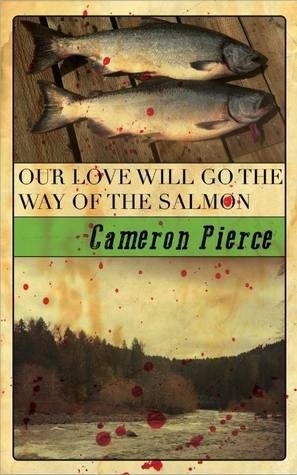
Review: Our Love Will Go the Way of the Salmon by Cameron Pierce (Broken River Books; 2014)

4 Jan

20150104-005659.jpg

“Our Love Will Go the Way of the Salmon”

A light surrealism permeates this tale. Pierce’s obsession is intriguing, especially if you reread his earlier works like The Ass Goblins of Ashuwitz or “The Elf Slut Sisters.” His voice feels more restrained, mature, and secure in this story, although it does border on Norman Mclean territory. This promises to be an intriguing evolution for one of the first bizarro writers I read 4-5 years ago.

“Sway”

This is a very funny story. Told from the POV of a Vietnam vet with foul, politically incorrect terminology, what begins like a cliched war story quickly becomes something entirely different and unexpected. I won’t spoil exactly how it develops, but I will say that Pierce’s twisted sense of humor surfaces in abundance so its earnest yet gruff tone is quickly undermined by Pierce’s satirical touch.

“Drop the World”

I have mixed feelings about stories told in the 2nd person, but it works well here. It drops you into the center of the action of a female boxing match. As the dreams and hopes of our protagonist spiral downward on a trail of auto-fume vapors, we encounter a surrealistic vision of the victor of the earlier boxing match intermixed with angel imagery. This one manages a downbeat ending that is still hopeful, even if that hope is smeared in rubble, debris, and delusion as the mouth in a body bag speaks.

“Short of Lundy”

This one has the structure of an imaginary encyclopedia of fantastic fish coupled with a simple story of a man and his father’s stories of fishing simple trout during his boyhood. Pierce’s whimsical imagination remains in full-display despite what the aforementioned synopsis might conjure. I particularly enjoyed the description of the last sea-monster sized fish eating cows and cranes.

“Help Me”

I read this story a few weeks ago in the anthology entitled Letters to Lovecraft. In that anthology, Pierce provides an introduction and states his love for “The Shadow Over Innsmouth” which is unsurprising given the fishy nature of its imagery and anthropomorphic concluding twist. This story seemed more complex and creepy reading it the second time through. I actually went back and read the last few pages for a third time before writing this. It seemed, on my second reading, the narrator had actually become the human-like fish that demanded help; on the third read, I noticed that the other fish remained in the car yet is referred to as “the firstborn.” This is my favorite one so far, and I’m happy I reread it. Probably the most straightforward horror tale of the collection.

“The Bass Fisherman’s Wife”

Wow. These keep getting better. There was something very elegant about the style of this one–very restrained and almost musically composed, if that makes any sense. It has a prim and proper style, like something out of Nathaniel Hawthorne yet with a decidedly Kafka-esque development. To summarize the events would do it a disservice–this one must be unveiled like a series of masterful paintings.

“Three Fishermen”

This odd trypich of tales do not fit together in any discernible puzzle or mystery, but maybe I should return to them at a later date to unlock their secrets.

“Floodland”

I loved this one. It has a slight Lost Highway feel to it while also revisiting the themes and imagery of “Help Me.” The narrator’s scene with his wife from a different life was handled well. This kind of story–with multiple planes of shifting realities–must’ve been difficult to pull off with such clarity and deceptive simplicity.

“The Incoming Tide”

Cosmic forces in tents and from the night. Missing elk by inches on slick roads after midnight. Slippery fragments, breaking but forming an arrow of energy towards a still-beating heart.

“Trophies”

A short somber tale that feels a bit like Hemingway without the drinking and contains zero fantastic elements. Still moving in its own way, like a more optimistic piece by Carver but also without the drinking.

“Let Love In”

We encounter another talking fish, although this one is fueled by bruised hallucination. In times of desperation, love can you make you do anything–even it that means trading flesh for fish at a dirty counter to hide reptilian eyes beneath the eaves.

“Easiest Kites There Are To Fly”

The title of this tales serves as a gateway to madness. Sad events lead a man to be haunted by a devil fish. Tempestuous relations with his father and wife also lead to him drinking too much and too often. The tale feels more like a fable or fairy tale than some of the others due to the whimsical feat of a man actually becoming successful, for a short stretch, selling small easy kites to fly.

“The Snakes of Boring”

This story, the longest in the collection, moved at an exceptionally fast pace due to its humor and hardboiled plot. Despite some ludicrous developments along the way, the story remained compelling–sort of like an Ealing comedy (think Kind Hearts and Coronets and The Lavender Hill Mob (I’m thinking of the imbecilic plan at the catfish farm that, of course, goes horrendously wrong). I won’t spoil other twists in the goofy but macabre plot.

“California Oregon”

This is an intense, choose-your-adventure style piece. While the form is used ironically, the emotions are harrowing and unsentimental. A very beautiful story that I will never forget.

“Our Love Will Go the Way of Salmon”

Sort of epilogue to a genuinely original collection of short stories. I read this while staying at a house on Lake Rupanco in southern Chile. Though I don’t usually fish, I did a bit while staying here. I also looked for salmon in a nearby river. Maybe someday I will again.

Get Our Love Will Go The Way of Salmon.

Review: Hung Hounds by Donald Armfield (Riot Forge; 2014)

2 Jan

20150102-123735.jpg

Dog creatures sit at the bar slurping from their drinks. He went away for just a little while after eating all those wings on wing night. He went to the bathroom and returned to a darkened, altered world.

Eventually, we end up in alternate version of Saudi Arabia where kinky sisters have their way with a wart-infested dwarf character. Men wearing tutus holdup a convenience store disguised by camel hair mustaches.

The hung hounds arrived from an alternate dimensions where the sky turns orange during their endless mating season.

Blurry maps in the shapes of genitals analyzed by an older gent in a jock strap at the village store. Herein lies the direction to the quest for the golden statue.

Hulk Hogan appears in an alternate dimension. The kinky sisters get half-eaten then sewn back together by a monkey. Then there’s gory battle with the hung hounds.

Hung Hounds is goofy but funny and fun. If you like Bradley Sands’ stuff (TV Snorted My Brain, Sorry I Ruined Your Orgy, etc.), you’ll surely love this one.

Wacky, zany, sex-fueled escapades will keep you laughing or scratching your head. If you want Indiana Jones bizarro, you have found it.

Check out more about Riot Forge and Donald Armfield here

Review: Armadillo Fists by Carlton Mellick III (Eraserhead Press; 2011)

24 Dec

20141223-235113.jpg

Armadillo Fists has a non-linear structure but is still incredibly easy to follow. The concept is both bizarre and funny. I especially liked the ideas of “Dop”(doppelgänger) conventions, having living armadillos for hands, driving dinosaur-shaped cars, and a legless and armless character who, over the course of the book, became quite likable while remaining funny.

Armadillo Fists owes just a little bit to Reservoir Dogs (and Carlton Mellick III acknowledges his debt to Quentin Tarantino in the introduction, in addition to Neil Gaiman’s “urban fantasy” works (this seemed less apparent, although the only “urban fantasy” work of his I’ve read is Neverwhere)), but the influence is slight and does not detract from this work’s utter originality.

I did grow a bit bored during some of the sections of cartoonish violence, but Carlton Mellick III has a way of introducing consistent surprises and unexpected concepts to keep the pages turning and reader feeling both time and money were well spent.

Find out more about Carlton Mellick III’s work here.

Review: The Mondo Vixen Massacre by Jamie Grefe (Eraserhead Press; 2013)

22 Dec

20141221-234603.jpg

Cinematic techniques and odes abound, although the language is sensory rich and visceral. Humiliation and degradation steam off every page.

It feels like we drift at the periphery of a great b-movie. Little details and tropes–Russ Meyer dialogue, throwaway phases like ‘hundred dollar handshake’, 70s exploitation film iconography and motifs, etc. This is not to say this novella is at all a hollow rip-off of any one b-movie or an unimaginative fanboy ode to such cinema; on the contrary, The Mondo Vixen Massacre is stylistically ambitious and unique.

The interesting thing about the New Bizarro Author Series is that almost none of the authors I’ve read so far fit into the bizarro mold completely; sure, there are lap-overs, shared themes, sensational titles, gaudy cover art, etc. Someone like Carlton Mellick III is such an excellent storyteller that one wishes some of the NBAS did fit more neatly into the bizarro mold. A few of the titles managed to be both aimless and formulaic. The Mondo Vixen Massacre is not one of those.

I took slight offense to Phil Spector being referred to as “pathetic.” We’ll have to see what music this author prizes. [Okay, Otis Redding and possibly grindcore. Not bad. ]

I notice a heavy Tarantino influence throughout, particularly during the hyperbolic fight scenes (beheadings, fire exploding from Vixen orifices, etc.). Yet then it gets more surreal, moving beyond the Tarantino realm, yet still retaining cinematic language (okay, obviously I know what a close-up, although I did pause to wonder what a “jiggle cut” might be).

The Mondo Vixen Massacre just gets wilder and loopier as the tale winds to its compact yet outrageous close.

Review: The Egg Man by Carlton Mellick III (Eraserhead Press; 2008)

21 Dec

20141221-093032.jpg

This one can be read in a single enjoyable sitting. The image of the egg man is one I’ll not soon forget. The post-apocalyptic setting is similar to Crab Town–and, to a lesser extent, Warrior Wolf Women of The Wasteland–but the concept is completely different here.

Society has been divided into different classes based on sensory ability (smell, touch, sight, etc.). There is a palpable sense of dread in the day-to-day experiences of our doomed but all-too-human protagonist: his neighbors are unfriendly and secretive, except for a crude woman he caught giving birth to thousands of flies.

I read somewhere that Carlton Mellick III fully advocates following the heroic journey structure. I thought about this as I read this book. Despite its wacky premise and grotesque imagery, it is clear that Carlton Mellick III follows this structure. But, then again, as rooted as this structure is in classic myth perhaps when we talk about storytelling we are really talking about the heroic journey structure.

Anyway, I was absorbed by the story in The Egg Man the entire time. And, despite following the heroic journey structure, I would not argue that this story is predictable.

Its simple, direct style with its odd premise and rule-playing structure makes it read like a fairy tale for adults.

See what Carlton Mellick III is writing with his furiously unstoppable pen and boundless imagination here.

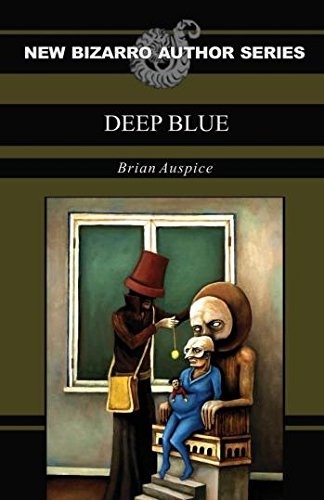
Review: Deep Blue by Brian Auspice (Eraserhead Press; 2014)

17 Dec

20141216-231924.jpg

Devils in fridges. The door opens and closes. A woman pancakes, disappearing through a crack in the floor. The narrator buys another little man.

Deep Blue is reminiscent of a Lenora Carrington painting.

Posters of Abraham Lincoln standing next to a log. An obese man eats his own cigar then points to an elevator which leads nowhere.

Colors dominate the Roland Topor-esque cityscape. They filter experiences, draw the wandering narrator forward past new boundaries as he tries to buy more little men in cans for his machine and the blue devil in his fridge, and call out to him as if grasping the wand or brush of the mad painter as he scribbles vivid faces on blank masks in a movie theatre where the attendees watch him instead of the film.

Women melting into brick as he is whisked away by cab drivers requiring no fare. Yet it may not have been fair the way his mother treated him, preferring to listen to the newscaster rattle on about the weather than to talk to him.

The many psychologist decapitated heads in the dumpster may believe in reality, but the receptionist who chose to melt into a bloodstain in the carpet did not.

Siamese starfish were meant to be removed from stepmothers. An old man rides a centipede during John’s ambitious journey to become a man in a can.

This book is excellent. Vaguely nightmarish, the language is stripped-down and the intuitive plot is trippy. There is a heavy emphasis on redundant suicide and nausea. The voice remains deadpan, no matter how ridiculous or dream-like the unfolding events become.

I thought about Phillip Jose Farmer’s “Sliced-Crosswise-Only-On-Tuesday World” but as there were no seemingly intentional direct references, I remain unsure as to whether Auspice ever read that particular tale.

Check out Deep Blue and Brian Auspice’s blog.

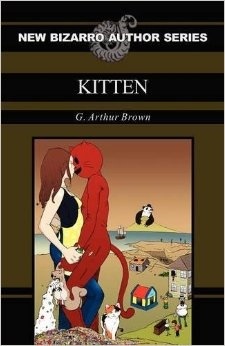
Review: Kitten by G. Arthur Brown (Eraserhead Press; 2012)

15 Dec

20141215-005403.jpg

Kittens who are not kittens who throw up stamps are not as dangerous to one’s sanity as the cat lady living next door with over 20 imaginary cats defecating all over her house. Yet this dead girl who emerged from the trunk of their attic existed because of the grandfather’s experiments.

This whimsical novella is compact, tight, excellently written, and hugely inventive. It also features time travel and is consistently surreal, in the classical school of painters and filmmakers sense.

When a dead boy is used as a puppet on an island run by children, the goofiness that exploded like napalm in the previous 25 or so pages vanished and offered a brief respite and a ray of hope for the more sinister first section of Kitten. There was a medium modicum of darkness during an Alice in Wonderland-driven segue through riddles threatening cracks in comforting logic, the blanket of which we clutch ever so tightly as the moon erupts his warty smile.

There were some interesting quasi metafictional moments as well–an awareness of certain characters coupled with a near willingness to break the fourth wall as they compared the transpiring events to Guy Maddin and Gogol.

In the end, we ride a sleigh backwards and discover the frozen icicle fingers of the ghoul dangling just beside the sleigh’s bells.

Check out more mind-melting work from Arthur G. Brown.

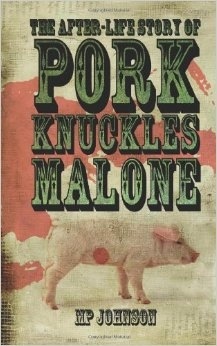
Review: The After-Life Story of Pork Knuckles Malone by MP Johnson (Bizzaro Pulp Press; 2013)

14 Dec

20141214-175801.jpg

I decided to read some of MP Johnson’s stuff because I’m working on a story to submit to his anthology about G.G. Allin. I read a hilarious flash fiction piece about maggot infested dolls in a Strangehouse Books Christmas anthology. I then wanted to read his newest book, Dungeons and Drag Queens, but it is not available digitally. I currently live and work in Bolivia where it is difficult to receive physical books. Then I discovered he’d written this other book called The After-Life Story of Pork Knuckles Malone.

This one pulls off a brilliant trick of rhetoric: its voice contains the cadences of a southern farmer accent coupled with pearls of farm-wisdom in a tone that borders on satirical but does not fully embrace its own irony.

Paper-mache-praying-mantis-mask-bedecked meat lovers abound. As do shacks haunted by pig spirits and baby arms where genitalia should be and filthy aunts and uncles in shock-rock punk bands.

House flies fall in love with Hitler as a boy remains love with his pet pig even after it is turned into cured ham. A Fight Club-like sequence follows as the novella’s ties to reality just gets looser and looser. A drag queen is introduced in a hitch-hiking experience gone wrong. A trippy sequence of interstellar space travel that becomes a weird amalgam of psychosis and blended genres (fantasy, science fiction and horror follows).

The novella ends with a bizarre concert scene that brought to mind the cult film Bad Boy Bubby–I’m not sure if MP Johnson has seen this film or if it was an intentional reference.

The book is a wacky and funny surreal adventure tale that will leave you chuckling and dumbfounded. Think of these scatterbrained notes and fractured summary as invitation for the psychedelic-horror inclined.

Check out MP Johnson’s blog and more info about his books here.

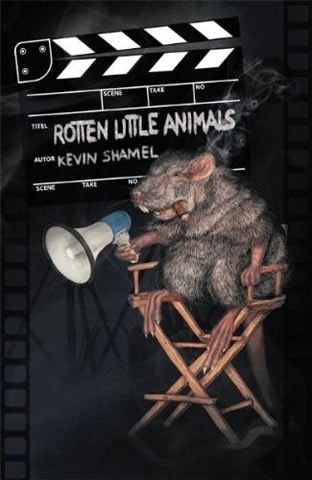
Review: Rotten Little Animals by Kevin Shamel (Eraserhead Press; 2009)

14 Dec

20141213-212955.jpg

Filthy animals directing films take a break to be rotten little voyeurs. You see: humans used to know animals could talk but they forgot.

What proceeds is a wildly unpredictable, crass, violent, and odd novella with plenty of action.

After the wicked carnage following the completion of a film about the kidnapping of a human boy, revenge is taken. From there, this gross but goofy gem of a novella hallucination gets wackier and wackier. The traumatized boy getting swallowed by a whale puppet is another highlight.

68, 412 ants talk in unison through a megaphone as a skunk sits in a director’s chair. Car chases through Yellowstone will have you on the edge of your seat until the novella’s shocking, yet surprisingly happy, climax.

Shamel writes in a clipped noir style yet his imagination is boundless. His plotting is daring and unexpected. He also has an original sense of humor. Bizzaro is a fun genre. Sometimes I struggle to identify what exactly unifies its authors in terms of approach, but this is one of the stronger examples I’ve encountered.

This will be a special treat for those who enjoyed the cult film Meet The Feebles, although that is not to say this is at all riding on its coattails. This is an entirely different beast altogether, full of more mind-bending ideas in a short psychedelic punch to consciousness than a poisonous mushroom.

Check out Rotten Little Animals at Eraserhead Press.